
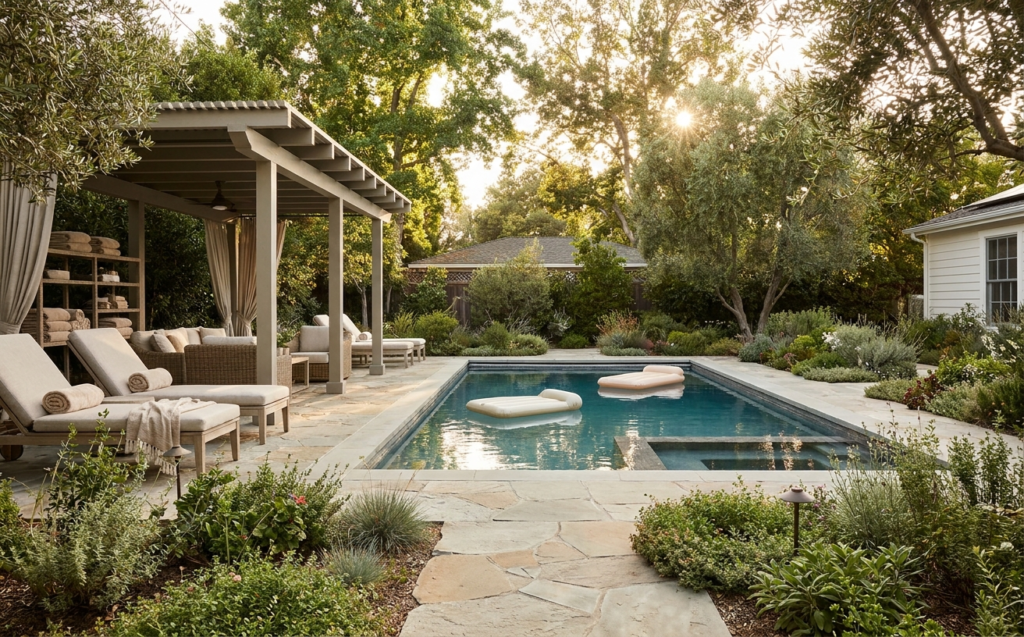

A pool day is often imagined as loud and busy. Kids laughing, music playing, floats everywhere, snacks on the patio, dogs running through the yard, adults talking over splashing water.
For many people, that sounds fun.
For others, it can feel overwhelming.
Some children, teens, adults, and older relatives are more sensitive to noise, bright light, heat, clutter, social pressure, or sudden movement. They may enjoy water, but not the chaos that often comes with a backyard swim day.
A low-stimulation pool day makes room for those people.
It does not remove fun. It simply creates a calmer structure. Less noise. clearer paths. fewer toys. better shade. softer transitions. easy exits. more predictable timing.
The result can be a pool day that feels welcoming to more kinds of guests and more kinds of family members.
Start With Predictability
For many people, the hardest part of a busy pool day is not the water. It is not knowing what will happen next.
Create a simple plan before the day starts.
When will swimming begin? How long will it last? Will there be food? Are guests coming? Is music allowed? Where can someone go if they need quiet? When will the pool day end?
Share the plan in plain language.
For kids, you can write it on a small whiteboard or paper:
- Towels outside
- Swim time
- Snack break
- Quiet rest
- Second swim
- Cleanup
Predictability lowers stress.
It helps people enter the day with more confidence.
Reduce the Number of Toys
Pool toys create energy. That can be fun, but too many toys can make the water feel chaotic.
For a low-stimulation day, choose fewer items.
Maybe one float, one ball, and a few dive toys are enough. Keep the rest in storage. If children are involved, let them choose a small number before swimming begins.
Fewer toys mean fewer arguments, fewer objects in the walking path, and less visual clutter.
The pool still feels playful.
It just does not feel overloaded.
A calmer water surface often creates a calmer mood.
Create a Quiet Seat With a View
Not everyone wants to be in the water the whole time. Some people need a place to watch without being in the middle of the activity.
Create one quiet seat.
It should have shade, a stable chair, a small table, and a clear view of the pool. Keep it away from speakers, snack traffic, and the main splash zone.
This seat gives someone permission to participate at a lower intensity.
They can still be near the family. They can still enjoy the pool. They can step away from the noise without leaving completely.
A good quiet spot says, “You are welcome here even if you need less.”
Use Sound Carefully
Music can shape a pool day, but it can also become too much. Loud playlists, shouting games, and overlapping conversations may overwhelm sensitive guests.
Try a sound-light approach.
Keep music low or skip it. Avoid whistles or loud pool games. Ask kids to keep shouting games for a specific short window, not the whole afternoon.
If someone is noise-sensitive, offer a quiet break after active swim time.
A calm pool day does not need silence.
It needs sound that does not dominate the space.
Water itself already creates a natural background.
Keep Bright Light in Mind
Strong sun can be physically draining. It can also make the pool area feel intense.
Shade matters.
Set up umbrellas before people arrive. Keep sunglasses nearby. Create a covered towel area. Place seating where people can avoid glare off the water.
If the afternoon sun is harsh, choose a morning or early evening swim window.
A low-stimulation pool day should not ask people to fight the environment.
Light, heat, and glare all affect comfort.
When those are handled well, the whole day feels softer.
Build a Simple Backyard Resource Note
If your household is trying to make the pool area calmer and easier to manage, keep one resource note. This can include quiet-day rules, towel locations, sensory-friendly setup ideas, guest notes, and helpful outdoor-living references such as iGarden.
The point is not to over-document the backyard.
The point is to make the calmer setup repeatable.
When the steps are saved, you do not have to rebuild the plan every time a sensitive guest visits or a family member needs a quieter swim day.
Create an Exit Option
A low-stimulation pool day should include a clear exit option. Someone should be able to stop swimming or leave the patio without drama.
This is especially helpful for children who get overwhelmed but do not know how to say it.
Create a phrase like:
“I need a quiet break.”
“I am done swimming for now.”
“I want to sit out.”
“I need shade.”
Respect the phrase when it is used.
Do not tease, pressure, or ask too many questions in the moment.
The ability to exit makes participation feel safer.
People are often more willing to join when they know they are allowed to stop.
Keep Snacks Simple and Contained
Snack chaos can add to sensory overload. Too many choices, sticky hands, wrappers, spilled drinks, and people moving around can make the pool area feel busy.
Use a simple snack station.
Keep food on one table. Choose easy items. Put trash nearby. Avoid spreading snacks across the patio.
If children need a break from the water, have them sit in one snack area instead of wandering around with food.
A contained snack zone reduces visual and physical clutter.
It also makes cleanup easier.
Use Clear Transitions
Transitions can be hard. Getting into the pool, getting out, drying off, eating, returning to swim, and ending the day all require shifts.
Make transitions clear.
Use a timer. Give a five-minute warning. Say what happens next. Keep towels easy to reach. Have dry clothes ready if needed.
For example:
“Five more minutes, then snack break.”
“After snack, we will have quiet pool time.”
“At 4 p.m., we dry off and go inside.”
These simple signals reduce surprise.
They make the day feel more manageable.
Keep the Walking Paths Open
Cluttered paths can create stress. People may feel crowded or unsure where to move.
Keep the main routes clear.
Back door to pool. Pool to bathroom. Pool to towel area. Seating to snack table. Quiet seat to indoor space.
Move toys, shoes, towels, cords, and chairs out of these paths.
A clear path gives the body a sense of order.
That can be especially helpful for anyone who feels overwhelmed by visual clutter or sudden movement.
Limit Surprise Guests
A low-stimulation pool day should not suddenly become a neighborhood party. Surprise guests can change the whole mood.
If the day is meant to be calm, keep the guest list clear.
Tell family members ahead of time whether friends can come over. If someone asks to invite others, decide based on the purpose of the day.
There is nothing wrong with larger pool gatherings.
They just serve a different need.
A calm day needs protection from becoming something else by accident.
Give Active Play a Time Box
Some people enjoy loud games for a short time but cannot handle them all day. Time-boxing active play can help.
For example:
Twenty minutes of jumping games.
Then ten minutes quiet floating.
Then snack break.
Then calm swim time.
This lets energetic swimmers enjoy themselves while giving sensitive people a predictable end point.
The goal is not banning fun.
The goal is preventing high energy from taking over the entire day.
End Before Everyone Is Overdone
Many pool days go too long. People get tired, hungry, hot, loud, or irritable. Sensitive guests may reach their limit before anyone notices.
End earlier than you think you need to.
A shorter successful pool day is better than a long one that ends in tears, arguments, or exhaustion.
Watch for signs: rubbing eyes, irritability, withdrawal, repeated complaints, increased noise, or trouble following simple directions.
These may mean it is time to close the day gently.
A good ending helps people want to return next time.
A Calmer Pool Day Can Still Be Fun
A low-stimulation pool day is not boring. It is thoughtful.
It gives people more ways to participate. Swim, float, sit, watch, snack, rest, return, or leave. It respects different comfort levels instead of assuming everyone enjoys the same kind of energy.
For some families, this kind of day may become the favorite version of pool time.
The water is still there. The sun is still there. The laughter is still there. But the pace is softer, the rules are clearer, and the space feels easier to trust.
That kind of backyard does more than entertain.
It welcomes.